
Wheel of Mictlan: How the Aztec Underworld and Wheel of Fate Shape Gameplay
Wheel of Mictlan is a Play’n GO video slot released on 19 March 2026, built around Mictlan, the underworld known from Aztec mythology, and its ruler Mictlantecuhtli. The game uses a traditional 5-reel, 3-row layout with 10 fixed paylines, but its identity comes mainly from the way the theme is connected to special features. An ancient stone wheel dominates the setting and acts as the central device for several bonus outcomes, while Flip Wilds, Free Spins and a Cashpot mini-game add further changes to the standard reel action. The result is a slot in which the mythology is more than background decoration, although the developers also take clear creative liberties. Mictlan and Mictlantecuhtli have historical roots in the beliefs of the Nahua peoples, while the rotating wheel is a game-specific interpretation rather than a historically documented element of Aztec religion.
Mictlan as the Narrative Foundation of the Slot
The name immediately establishes the main reference behind the game. Mictlan was the realm of the dead in Aztec belief and was traditionally described as a multi-layered underworld. Accounts commonly describe nine levels or regions that souls had to pass through before reaching their final destination. This was not simply an equivalent of the Christian idea of hell. The journey was connected with death, transformation and passage through a series of difficult stages. Play’n GO does not reproduce those stages individually, but it borrows the idea of entering a mysterious domain controlled by forces outside the traveller’s influence.
That distinction matters because Wheel of Mictlan is an entertainment product rather than a literal reconstruction of pre-Columbian beliefs. The reels are surrounded by jungle vegetation, weathered stone, carved masks, temples and large guardian figures. Greens, golds and earthy stone colours dominate the scenery, producing a setting that is recognisably inspired by Mesoamerican imagery without attempting to recreate a particular archaeological site. Instead of turning the underworld into a completely dark or threatening environment, the designers use bright symbols and animated details to keep the screen readable during normal spins.
The game also uses the theme to establish a particular rhythm. Ordinary spins take place in a relatively stable temple setting, while special symbols cause parts of that environment to become more active. Wild reels expand, the large wheel moves into focus and Mictlantecuhtli becomes more visually prominent. These transitions give bonus events the impression of moving deeper into the game’s fictional version of Mictlan. There is no fixed progression through nine stages, so players should not expect a level-based adventure. The connection is thematic: movement from an ordinary reel state towards increasingly elaborate bonus events echoes the broader idea of passage into an underworld.
How Mictlantecuhtli and Temple Imagery Influence the Experience
Mictlantecuhtli is one of the strongest links between the slot and its mythological source. In Aztec tradition he was associated with death and ruled Mictlan. Surviving representations frequently give him skeletal or skull-like features, which helps explain the character design used by Play’n GO. In Wheel of Mictlan he watches over the reels from the temple setting, giving the game a recognisable central figure rather than relying only on generic masks, gold objects and stone buildings to communicate its theme.
His role, however, is primarily presentational. Play’n GO specifically explains that Bonus symbols can make Mictlantecuhtli appear to grow during a Bonus Wheel sequence before he returns to his normal size. This animation does not improve a prize, change the probability of an outcome or activate a separate mechanic. It is a useful example of the difference between visual feedback and functional gameplay. A large animation may make a bonus sequence feel more significant, but the result continues to depend on the rules of the feature rather than the size or movement of the character on screen.
The stone wheel receives a more functional role. Play’n GO describes it as the story’s central device, with the temple, guardians and Mictlantecuhtli contributing to the surrounding theatre. This is where artistic interpretation becomes especially important. A player should not assume that the wheel represents a specific ancient Aztec mechanism for deciding fate. Within the game it is a fictional device created to connect the narrative idea of uncertainty with a recognisable slot feature. It works because its visual role and practical role are aligned: the wheel represents unpredictable fate in the story while also selecting between different bonus results during play.
How the Wheel of Fate Changes the Rhythm of Play
Normal gameplay follows the familiar format of a 5-by-3 slot with 10 fixed paylines. Winning combinations are therefore easier to follow than in games built around hundreds or thousands of variable win ways. The simpler base structure also leaves more room for the special features to create noticeable changes. Wheel of Mictlan does not depend on a continuously changing reel grid or a long sequence of permanent upgrades. Instead, much of its variation comes from particular symbols that temporarily alter reels or transfer the action away from the normal game.
The Bonus symbol is especially important because it performs more than one job. It functions as a Wild on the reels, helping complete eligible winning combinations, but it is also connected to the Bonus Wheel. Bonus symbols have a chance to activate the wheel, while landing three guarantees the feature. This means the wheel is not merely an occasional decorative screen. It is directly connected to a symbol that can already influence ordinary reel results, creating a visible link between the base game and the main bonus mechanism.
Once activated, the Bonus Wheel can award one of four categories of outcome: a multiplier, an instant prize, Free Spins or access to the Cashpot feature. That range is important to the way the slot feels because the same trigger does not always lead to the same type of reward. One activation can resolve quickly through a direct prize or multiplier, while another may move the player into a longer Free Spins sequence or the separate Cashpot mini-game. The wheel therefore creates variation without requiring players to learn a large collection of unrelated rules.
Wild Flip and Free Spins: The Main Supporting Mechanics
Flip Wilds provide the most visible change to the regular reel layout. During the base game, landing two or more Flip Wild symbols activates the WILD FLIP feature. Each qualifying Flip Wild then has a chance to change into a full-reel Wild. An expanded Wild can cover all three positions on its reel, making it more useful for completing line combinations across several paylines at once. Expansion is not guaranteed for every Flip Wild, so the appearance of the triggering symbols should not be treated as a promise of a particular win.
Free Spins make this mechanic easier to activate. Three Scatter symbols trigger 10 Free Spins, and the round can be retriggered by landing the required Scatters again. During these spins, only one Flip Wild is required to activate WILD FLIP rather than the two needed in normal play. This small rule change is important because it gives the bonus round a different character without replacing the core mechanics. Players already understand what a Flip Wild does before entering Free Spins; the feature simply appears under more favourable triggering conditions during the bonus.
These mechanics also help explain the relatively high payout potential reported for the game. Current 2026 listings describe a maximum win of up to 40,000 times the total bet, although reaching the theoretical maximum is an exceptional outcome rather than a normal expectation. The combination of expanded Wild reels, bonus outcomes and Free Spins creates the possibility of substantially different results from one round to another. The quoted maximum should therefore be understood as a mathematical ceiling defined by the game rules, not as an indication of what a player is likely to receive during an ordinary session.
Cashpot and the Role of Chance in Wheel of Mictlan
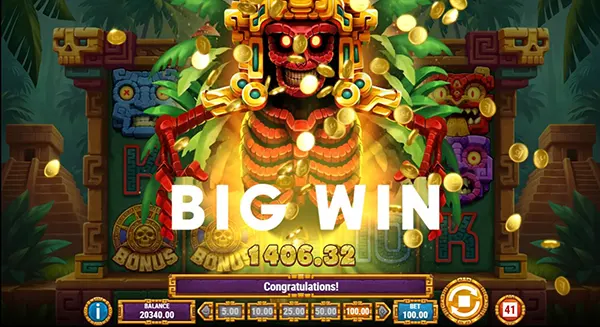
The Cashpot feature is the most separate of Wheel of Mictlan’s bonus mechanics because it temporarily moves away from the normal reels. Access comes through the Bonus Wheel: if the wheel selects Cashpot, the player enters a Match 3 mini-game built around a wall of skull symbols. The player reveals hidden results until three matching Cashpot tiers have appeared. The matching tier determines the resulting Cashpot award. This creates a simple interaction that can be understood without learning additional reel patterns or paylines.
The skull imagery gives the feature a clear connection to Mictlan and to Mictlantecuhtli’s association with death. Mechanically, however, clicking a particular skull should not be confused with a skill-based decision. The mini-game presents choices visually, but it remains part of a game of chance. There is no reliable pattern that allows a player to identify a better skull before selecting it, and previous outcomes do not provide a practical method for predicting later ones. The feature is designed to make the result more interactive, not to turn the slot into a strategy game.
This difference between interaction and control appears throughout Wheel of Mictlan. A player starts spins and makes permitted selections when a feature asks for input, but the important outcomes remain determined by the game’s random mechanics. The wheel reinforces that principle particularly well. Visually, it suggests fate selecting one direction from several possibilities; mechanically, it distributes different types of bonus result. The theme and the game rules therefore point towards the same idea: anticipation comes from not knowing which permitted outcome will appear next rather than from mastering a hidden sequence.
What Players Should Know Before Playing in 2026
One figure that requires particular attention is RTP, because the value displayed for Wheel of Mictlan is not identical in every 2026 listing. Some current operators list a 94.2% version, while game databases and reviews also report configurations around 96%. This kind of variation is possible when a supplier provides more than one approved mathematical configuration. For that reason, the relevant figure is the RTP shown inside the actual game information or help section at the casino where it is being played. A value quoted by another website should not automatically be assumed to apply everywhere.
Volatility should also be considered separately from RTP. Current listings generally describe Wheel of Mictlan as medium-high or high volatility, which fits its dependence on Wild expansions and bonus features for some of its more substantial outcomes. In practical terms, this means results can vary noticeably over shorter sessions and larger wins need not appear frequently. RTP, volatility and the 40,000x maximum all describe different aspects of the game. None of them predicts the result of the next spin, and a theoretical long-term return does not mean that a player will receive a similar percentage of their stake back in one session.
Wheel of Mictlan is therefore most accurately understood as a feature-led slot that uses mythology to organise its mechanics rather than simply decorate them. Mictlan provides the underworld setting, Mictlantecuhtli gives that setting a recognisable ruler, Flip Wilds alter the reels, Free Spins lower the threshold for WILD FLIP, and the Bonus Wheel connects multipliers, instant prizes, Free Spins and the Cashpot mini-game. The historical inspiration and the fictional additions should be kept separate, but together they create a coherent design. Players who choose to use the game with real money should still treat every stake as entertainment expenditure, check the rules and RTP of the version available to them, and set spending limits independently of previous wins or losses.