

Sugar Rush — slot review and mechanics (2026)
Sugar Rush is a 7×7 cluster-pays slot from Pragmatic Play, built around tumbling wins and a position-based multiplier system that can scale sharply in the right sequence. The game looks simple on the surface, but most of the value sits in how “marked” grid positions turn into multipliers, and how that behaviour changes once Free Spins are triggered. As of 2026, the core rules have stayed consistent since launch, so you can focus on learning the model rather than chasing patch notes.
Game setup: grid, bets, RTP versions and volatility
Sugar Rush uses a 7 reels x 7 rows grid and pays via clusters, not paylines. A winning cluster forms when 5 or more identical symbols connect horizontally and/or vertically; diagonals do not count. After a win, the tumble feature removes the winning symbols and drops new ones in, allowing chain results until no new clusters appear.
The betting range is typically 0.20 to 100 per spin, which makes the slot workable both for low-stake sessions and for players who prefer larger stakes. Because the grid can create several separate clusters in one tumble sequence, your stake level mostly affects how “expensive” it is to wait for the feature moments rather than changing the underlying rhythm of the base game.
For RTP, you will often see 96.50% quoted as the default, but operators can run alternative builds (commonly lower). In practical terms, that means two players can be playing “Sugar Rush” on different sites and still be on different RTP settings. In 2026, the simplest habit is to open the in-game info panel before you start and confirm which RTP version is active, especially if you are comparing venues.
Symbols and the triggers that matter in real play
The symbol set is candy-themed and straightforward, but the important point is what the game does not include: there are no Wild symbols in Sugar Rush. That design choice keeps outcomes more dependent on tumble sequences and multiplier positions than on sudden Wild-driven line expansions.
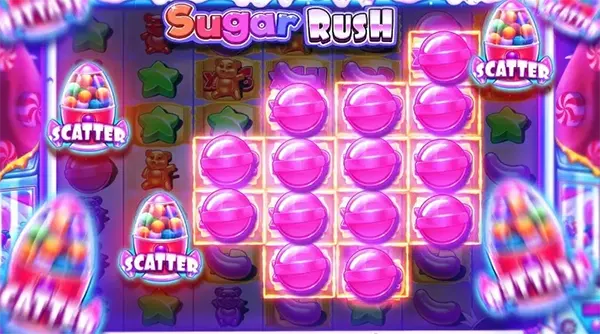
The Scatter is the Candy Machine. Free Spins trigger when 3 to 7 Scatters land within a single tumble sequence, not simply on a single settled grid. That distinction matters because a tumble can “complete” the trigger after the first hit, and it is one reason Sugar Rush can feel quiet for a while and then suddenly flip into a feature without much warning.
The Free Spins ladder is also more granular than many players expect: depending on how many Scatters appear in that tumble sequence, the award scales up (commonly 10, 12, 15, 20, or 30 spins). Retriggers follow the same ladder during the bonus, which is why protecting your bankroll for variance is more realistic than expecting frequent, evenly sized bonus rounds.
How the multiplier spots work in the base game
Every time you land a winning cluster, the positions that were part of that win become “marked.” Marking itself does not pay; it is a setup step. In the base game, those marks exist only for the duration of the current tumble sequence, so once the chain ends, the grid clears and you start fresh on the next paid spin.
A multiplier is created when a win happens on a marked position within the same tumble sequence. The multiplier starts at x2 and doubles each time that position is involved again in another win during that same chain, up to a stated cap (commonly x128 for a single position). This is why some spins look uneventful and others suddenly spike: the slot rewards repeat interactions with the same squares, not just “any” extra tumble.
When multiple multiplier positions are included in the same winning cluster, their values are added together for that win. That “additive across squares” behaviour is easy to miss if you only watch the animation, but it is central to the top-end outcomes: the slot is essentially asking you to build a map of boosted squares and then hit a large cluster that overlaps several of them at once.
Reading tumble sequences without inventing a system
There is no reliable way to predict when the game will build multipliers; it is random, and treating it as anything else is a fast route to overbetting. What you can do, however, is read what just happened: a tumble chain that creates multiple marked positions across the grid is “potential energy,” because the next hits in that same chain might land on those marks and start multipliers.
From a decision point of view, Sugar Rush is not about changing tactics mid-spin (you cannot), but about setting a stake that lets you survive the quiet stretches. High volatility here means long periods of small or no returns can be normal, while a small number of feature events account for a large share of total payout.
If you are playing in markets where feature buys exist, remember that availability is jurisdiction-dependent and can be disabled (for example, the UK commonly restricts bonus buys). Even where it is offered, it changes your variance profile rather than removing it, because the bonus can still underperform. The more honest framing is: it shifts when you pay for volatility, not whether volatility exists.
Free Spins: persistence, retriggers and the 5,000x cap
Free Spins are where Sugar Rush becomes a different game. The key rule change is persistence: marked positions and their multipliers do not reset between spins during the feature. That means one Free Spin can set up boosted squares that the next Free Spin can exploit, and so on, which is the main reason the slot’s best outcomes are concentrated in the bonus round.
Because persistence carries over, the “shape” of your bonus matters. A feature that builds multipliers early gives itself more chances to convert them into large overlapping clusters later. Conversely, a bonus that spends most spins without creating useful marked positions can end quietly even if it technically had the same number of spins.
The maximum win is capped at 5,000x the total bet. This is not just marketing information; it affects expectations. A hard cap means that even in an exceptional run, payout cannot scale indefinitely, so bankroll planning should assume big hits are rare and bounded, not frequent and limitless.
Practical checks for 2026: RTP confirmation and responsible play
Before you commit to a session, confirm two things in the help/about screen: the RTP setting (since multiple builds exist) and the local availability of features such as bonus buys. This takes seconds and prevents the common mistake of assuming every Sugar Rush instance runs on the same maths.
Set a session budget and a stopping rule that does not depend on “getting a bonus back.” With high-volatility slots, chasing a feature can quietly turn into loss-chasing, because the game can legitimately go long stretches without delivering the moment you are waiting for.
If you notice you are increasing stakes to “force” action, that is a useful red flag. The slot does not respond to urgency, and the quickest way to protect your decision-making is to step away, cool down, and return only if you can play within a pre-set budget. Entertainment value comes from understanding the rules and keeping control, not from trying to out-stare randomness.