

Mental: analysis of its unconventional reel layout and elevated volatility
The slot Mental, developed by Nolimit City, stands out through an original approach to reel construction and a high-risk mathematical model. As of 2025, the game is regarded as one of the most complex titles in the studio’s catalogue, combining layered mechanics, stacked modifiers and unpredictable win patterns. This article examines its structure, risk profile and the technical ideas behind its distinctive design.
Unconventional reel architecture and core layout principles
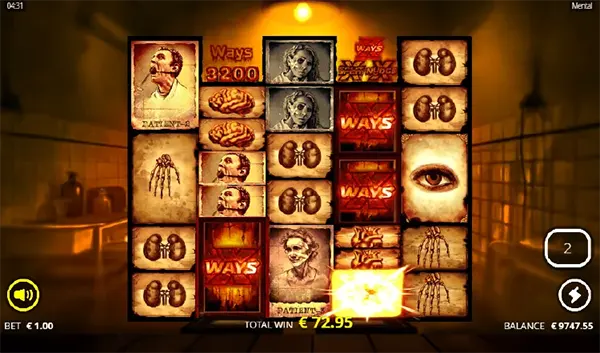
Mental uses a 3-2-3-2-3 setup, which already sets it apart from the majority of modern video slots. Instead of relying on uniform reels, the game arranges symbols on alternating rows. This configuration is not decorative: it influences the behaviour of winning combinations and determines how features interlock. The uneven geometry increases the number of symbol interactions, especially when modifiers affect individual positions rather than whole reels.
The layout supports the “Mental Transform” mechanic, which can rewrite the value of separate symbols. Because the reels contain a mixture of narrow and wide rows, transformation outcomes differ significantly from spin to spin. The engine evaluates positions independently and applies multipliers, splits or symbol upgrades without aligning them through traditional reel symmetry. As a result, two spins with identical base symbols may produce completely different outcomes once transformations are processed.
Another key aspect is the interaction between the layout and xWays/xSplit features. These modifiers expand or divide symbols according to the available row space. In a non-uniform grid, expansion does not follow predictable vertical patterns, so the player cannot easily foresee how many ways will emerge. This unpredictability contributes to the slot’s reputation for sharp swings and inconsistent but occasionally explosive winning clusters.
The role of symbol independence in shaping gameplay
In most classic slots, reels act as cohesive columns. Mental breaks this rule by prioritising symbol independence. Each position is treated as a separate unit capable of receiving upgrades, fractures or enhancements even when neighbouring symbols remain unchanged. This approach is similar to cluster-type logic but retains payline-based evaluation, giving the game a hybrid mathematical feel.
The independence principle also means that features often operate simultaneously rather than sequentially. For example, a symbol may first split, then transform, and finally receive a multiplier. Because each step is computed separately, the resulting chain grows in complexity. This has noticeable implications for the hit frequency: minor gains might be sparse, yet the game compensates through substantial top-heavy potential.
From a design perspective, this independence creates a high level of uncertainty. The player experiences irregular pacing, where straightforward spins can escalate into sudden multi-stage interactions. This unpredictability is fundamental to the identity of Mental and shapes the way its mathematical engine distributes value over long sessions.
High volatility and its mathematical consequences
Mental operates on a high-volatility model that prioritises rare but sizeable payouts. The distribution curve is skewed heavily towards the upper reward range, which is typical of Nolimit City’s extreme-risk catalogue. Such games often produce long sequences of uneventful spins, but the value of premium features compensates for the absence of frequent smaller outcomes.
The slot’s volatility is amplified by the stacked nature of its mechanics. Transformations, splits, multipliers and bonus enhancements do not function in isolation. Instead, they combine to produce compounding effects, especially in bonus rounds. Mathematical modelling indicates that the most significant wins require multiple systems working simultaneously, which explains the scarcity of high-value events during regular play.
Another factor influencing volatility is the interaction of dead spins with breakthrough features. Because the grid does not operate evenly, the game may produce long intervals of near-hits. This behaviour is intentional, as it allows the engine to reserve value for amplified sequences in bonus rounds while maintaining a consistent long-term return-to-player percentage across all stages.
Distribution of potential and the impact on session strategy
The uneven distribution of value pushes most of the game’s potential into rare combinations triggered within the bonus rounds. Players familiar with high-variance titles will recognise the pattern: extended base-game sessions with limited returns followed by isolated but impactful feature triggers. Mental follows this structure closely, with the biggest payouts arising from layered modifiers during free spins.
This makes session length a meaningful factor. Short sessions may provide limited access to core features, as the algorithm is designed to release its highest expected value through complex bonus sequences. By contrast, longer sessions increase the likelihood of interacting with the deeper mechanics but also expose the player to extended periods of low activity.
The mathematical model emphasises risk-reward balance rather than frequent engagement. For users who prefer steady, predictable outcomes, the slot may feel unstable. However, for those who appreciate high-risk engines, the layered structure and the rare convergence of multiple mechanics deliver an experience that remains technically distinctive even in 2025.
The influence of features on reel behaviour
The game includes several feature types designed to interact directly with the non-standard grid. The xWays modifier can expand symbols to cover multiple positions horizontally, and because rows differ in size, each expansion has unique effects. In the wider rows, expansions increase the number of ways significantly, whereas in the narrower rows, they primarily influence symbol distribution rather than raw way count.
Split mechanics further modify the reel behaviour by dividing symbols into two or more instances. In a traditional layout, splits have predictable outcomes, but in Mental, the effect varies depending on symbol placement. Splits in narrow rows generate compressed clusters, while splits in larger rows increase distribution density, amplifying the potential impact of multipliers.
Mental’s most distinctive feature involves multipliers applied to individual symbols rather than whole lines. This design magnifies the importance of symbol position. A high-value symbol landing in a narrow row may receive a multiplier but contribute fewer ways, whereas a similar symbol in a wider row creates a different risk-reward pattern. Thus, reel geometry is constantly influencing the outcome of feature interactions.
How reel modifiers shape unpredictability
The modifiers are designed to destabilise predictable win patterns. By combining expansions, splits and upgrades on a non-uniform grid, the system prevents players from accurately estimating outcomes during feature activation. Even experienced players cannot reliably anticipate the number of ways or the scale of multipliers after all mechanics are applied.
This element of unpredictability is central to the game’s identity. It creates a technical environment where the engine can produce both extremely low and exceptionally high outcomes from seemingly similar symbols. Such behaviour distinguishes Mental from slots built on more linear frameworks and contributes to its elevated variance rating.
Finally, the unpredictability supports long-term engagement. While the base game may feel demanding due to its volatility, the moments when features combine unexpectedly produce some of the most dramatic win sequences available in Nolimit City’s portfolio. This balance between uncertainty and potential has kept Mental relevant across multiple years of updates and 2025 compliance adjustments.